Choose your need
Monitoring options for pipeline infrastructure For the most critical assets in a pipeline network, real-time monitoring is essential, as operators need immediate insight into what is happening along the pipeline.
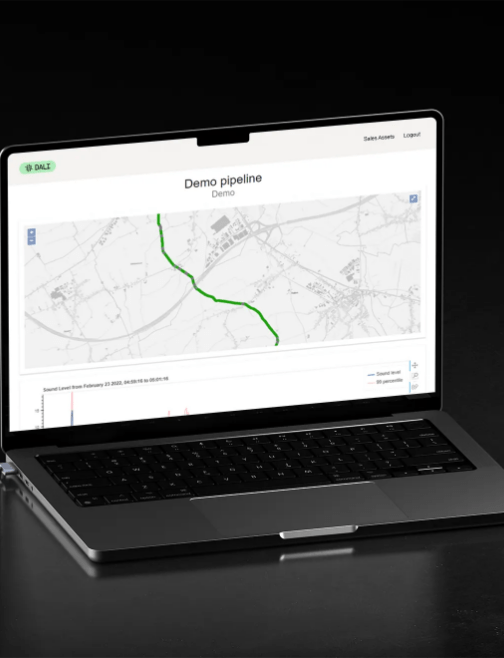
Our solution for this is DALI Monitoring. This system provides continuous 24/7 real-time monitoring of the pipeline. Both the fiber optic cable and the Distributed Acoustic Sensor (DAS), or intelligent laser unit, are installed permanently, enabling constant monitoring and immediate event detection.
For less critical assets, where continuous monitoring is not required but regular, cost-efficient inspections are desirable, we offer DALI
With DALI Flex, the fiber optic cable remains permanently installed, while the laser unit is connected only during inspection periods. Once installed, the system allows operators to inspect up to 40 km of pipeline within a single day or over a few days, using software-based analysis.
As a result, the inspection cost can be reduced by an order of magnitude compared to traditional inspection techniques, while also significantly improving operational efficiency.
This configuration is typically used for pilot projects or as a problem-solving tool, where DALI is applied as a traditional, temporary inspection technique.
If a pipeline requires regular inspections (for example annually), it is generally more efficient to leave the fiber optic cable installed permanently.
However, in situations where conventional inspection methods cannot provide a satisfactory solution, DALI Mobile can still serve as an effective problem-solving approach.
OUR BENEFITS
Leak detection is the most obvious one, but also wire breakages of steel-reenforced pipelines. But more broadly, the continuous insight into pipeline behavior allows utilities to significantly improve their asset management.: utilities can make better operational and strategic decisions, for example when prioritizing maintenance or planning renewal investments.
By providing continuous real-time data on pipeline condition and performance, DALI enables utilities to improve operational decision-making and long-term asset management.
The system detects events such as: leaks, wire breaks in pre-stressed concrete pipes, pressure transients, asset manipulation or abnormal activity
With accurate real-time information, utilities can prioritize maintenance and asset renewal investments, ensuring that limited resources are allocated where they are needed most.
Increased network resilience and safety In today’s geopolitically tense environment, where critical infrastructure can be targeted, DALI’s real time insight also strengthens network safety and resilience by enabling early intrusion detection.
DALI enhances the situational awareness of critical infrastructure.
The system can detect events such as: trespassing in sensitive areas, unauthorized manhole openings, vehicle or heavy machinery activity near pipelines, illegal asset manipulation, human presence or speech in restricted areas
This significantly improves network security and intrusion detection, helping utilities prevent incidents and respond more quickly.
When installing fiber optic cables inside pipelines, typically only one or two fibers are used for sensing, while a cable may contain up to 144 fibers.
This creates a fiber backbone across the pipeline network, often at a fraction of the cost compared to traditional trenching, which can be used for: remote monitoring and control of valves and sensors, secure internal communication networks, commercial telecommunications services
In some cases, utilities can lease unused fiber capacity to telecom operators, creating a new revenue stream that helps finance the monitoring infrastructure.